
Key Takeaways:
- A small number of AI founders are getting rich — most are not.
Headlines focus on a tiny group of elite, well-funded companies with massive distribution. These are real success stories, but they are not representative of the average AI founder. - Venture capital interest in AI does not equal widespread profitability.
AI dominates VC investment, but that capital is heavily concentrated at the top. Most AI startups struggle to generate consistent revenue, and the overall AI startup success rate remains low. - AI is accelerating inequality in business, not democratising wealth.
Rather than creating a broad new class of millionaires, AI is helping already-advantaged founders and big tech scale faster — widening the gap between hype and reality.
Are AI founders getting rich — or is it just hype?
As fears about AI replacing jobs continue to grow, many people are asking a different question:
if work is changing… who is actually benefiting?
Every few weeks, new headlines claim that artificial intelligence is creating a wave of overnight millionaires.
“AI minted more than 50 new billionaires in 2025.”
“AI boom creates record numbers of self-made millionaires.”
“AI will create more millionaires in five years than the internet did in two decades.”
The message is clear: if you’re not building an AI startup right now, you’re missing out.
But are AI founders getting rich — or are we mistaking headlines for reality?
Are AI startups really generating wealth?
So, are AI founders getting rich? At first glance, it certainly looks that way. Venture capital is pouring into AI. New tools launch daily. Social media is filled with stories of founders “hitting $1m ARR in months”.
To understand what’s really happening, we need to separate business creation from business success.
In the US, new business formations rose sharply after the pandemic:
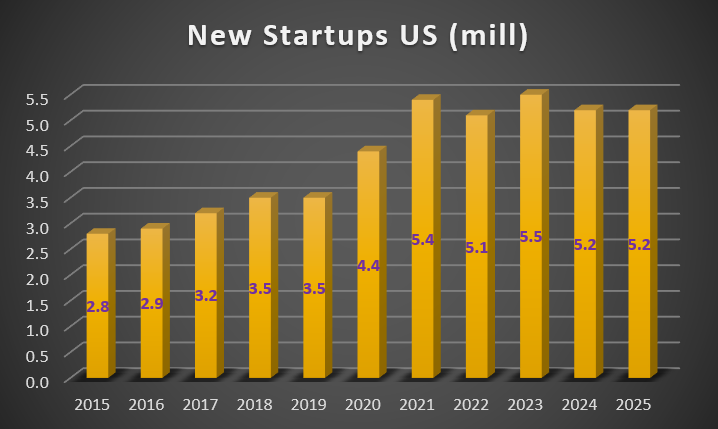
There was a clear post-pandemic surge, peaking in 2023 — the year after generative AI went mainstream. But attributing this rise purely to AI is misleading.
Most new businesses were driven by economic pressure, job insecurity, and a shift towards flexible work. Cheap digital tools and remote infrastructure lowered the barrier to entry. AI was part of the picture, but it wasn’t the main reason people started companies.
Moreover, more startups do not automatically mean more successful founders.
Do AI startups actually make money?
This is where the story gets uncomfortable.
While AI dominates venture capital headlines, profitability tells a different story. So, are AI founders getting rich? In the US, AI accounted for roughly:
- 25–30% of VC deal value in 2023
- 46% in 2024
- Nearly 60% in 2025
That level of concentration signals enthusiasm — not commercial maturity.
We’ve seen this pattern before. During the dot-com era, capital flooded into anything internet-related. Many companies were well-funded, widely discussed, and ultimately unsustainable. Boo.com, a UK fashion startup, famously raised $135 million only to collapse within 18 months after building technology that consumers simply couldn’t use at the time.
AI investment today shows similar characteristics. Money is chasing potential rather than proven demand, raising legitimate concerns about an AI venture capital bubble.

What is the real AI startup success rate?
When people talk about “successful AI businesses”, they usually mean companies like ChatGPT, Gemini, or Claude. These are impressive products, but they are not representative of the average founder.
A genuinely successful small AI business typically:
- Pays its founder a reliable income
- Has repeat customers
- Survives 12–24 months without funding
- Isn’t one pricing change away from death
These companies are hard to track because they don’t raise capital or issue press releases. But estimates suggest the number of bootstrapped AI businesses generating $1m+ ARR without funding is likely in the low hundreds globally.
Most AI startups launched in late 2022 or 2023 are already gone, even if their websites still exist. Hype fades quickly. Time does the filtering.
This is why the AI startup success rate remains far lower than the headlines imply.
Are AI founders getting rich at mass — or just the already powerful?
The structure of the AI economy reveals a deeper issue: concentration.
The Cloud 100, an annual ranking of the most successful private cloud software companies, shows that the top 10 companies accounted for 54% of the list’s value. At the extreme end, OpenAI alone is valued at roughly $300 billion — more than the combined value of many so-called “elite” startups.
This suggests that AI is not democratising wealth. It is an accelerating scale for those who already have distribution, capital, and infrastructure.
In the UK, this pattern is even clearer. While the number of AI companies has nearly doubled since 2022 to around 6,000, revenue remains heavily skewed:
- Large firms: 85% of AI revenue
- Medium firms: 8%
- Small firms: 5%
- Micro firms: 2%
Small and micro businesses combined generate just 7% of total AI revenue.
AI adoption is widespread. AI wealth is not.

Why headlines about AI wealth are misleading
Payment data is often used to reinforce the idea that AI founders are getting rich quickly. For example, Stripe has reported that the “top 100 AI companies” on its platform reached $1m in annualised revenue in a median time of 11.5 months.
That sounds extraordinary, until you examine what’s being measured.
This group is not representative of AI startups. It consists of already-successful, heavily funded companies, many of which have instant global distribution. Using this cohort to describe “AI founders” in general is a classic case of selection bias.
It tells us how quickly winners win, not how often founders succeed.
What the data actually suggests about AI and work
So where does this leave us?
Despite the narrative, AI is not creating a broad new class of wealthy founders. And it’s not replacing jobs at scale either.
Instead, what we’re seeing is:
- more people starting businesses due to economic pressure
- more competition, not more success
- more capital flowing to a small number of dominant players
The real story isn’t just about AI founders getting rich. It’s about who captures value as work changes.
Conclusion: Are AI founders getting rich?
So, are AI founders getting rich?
A small number are very quickly. But for most founders, the reality is far less glamorous. AI is lowering the barrier to starting a business. But it is not lowering the barrier to building a successful one.
And as with jobs, the biggest gains are not being distributed evenly. The real risk isn’t that you’re missing out on becoming an AI millionaire. It’s that you believe the narrative — and make decisions based on hype instead of reality.
People Also Ask
Are AI founders getting rich?
A small number of AI founders are generating significant wealth, but most are not. Success is concentrated among well-funded companies with strong distribution, such as OpenAI, Anthropic, and Nvidia.
What is the AI startup success rate?
The AI startup success rate remains low. Many startups fail within the first 1–2 years, especially without funding or a clear business model. Estimates suggest the number of bootstrapped AI businesses generating $1m+ ARR without funding is likely in the low hundreds globally.
Do AI startups actually make money?
Some do, but many struggle to be profitable. High investment levels do not necessarily translate into sustainable revenue, even though many headlines imply otherwise.
Is AI creating more millionaires?
AI is creating wealth for a small number of founders, but it is not broadly increasing the number of successful entrepreneurs. In the UK, small and micro businesses combined generate just 7% of total AI revenue.
Is AI changing work or creating new opportunities?
AI is reshaping work and lowering barriers to entry, but it is also increasing competition and concentrating value among a small number of winners.
About the Author
Antlerzz explores the intersection of AI, entrepreneurship, and human creativity — separating hype from reality to reveal how emerging technology truly transforms business.
At Antlerzz, we genuinely like AI — mostly. But we’re also realistic about its limits, and occasionally, those limits are… spectacular. For honest examples of where AI genuinely delivers and where the hype collapses, watch The AI Reality Check by Antlerzz on YouTube.
0 Comments